What Actually Breaks on Match Day (And How to Prevent It)
Every automated sports camera system looks flawless during the demonstration. Perfect framing, crisp uploads, seamless integration. Then match day arrives, and reality intervenes.
The gap between controlled testing and live operations isn't a technical mystery, it's a predictable pattern. After thousands of installations across professional and grassroots venues, the failure points are remarkably consistent. Understanding them is the first step toward prevention.
The Three Common Failure Points
Power: The Silent Vulnerability
Power issues account for an estimated 35-40% of match day technical failures in automated video systems. The problem isn't usually total blackout, it's the instability that lives in the margins.
Shared circuits with floodlights create voltage fluctuations. Temporary setups rely on extension cords that weren't designed for continuous loads. Older venues run systems on infrastructure built before high-resolution streaming was imaginable. Each of these scenarios introduces risk that never surfaces during a 90-minute demonstration.
The systems that survive match day are built with redundancy assumptions: dual power supplies, battery backup for critical components, and voltage monitoring that triggers alerts before failure occurs. It's unglamorous infrastructure work, but it's also the difference between recording the match and explaining why you didn't.
Network: Where Bandwidth Meets Reality (And Why Ownership Matters)
Network reliability is less predictable than power, which makes it more dangerous. A venue's internet connection might handle 4K uploads perfectly during setup, then collapse under load when three other systems start streaming simultaneously.
The variables multiply quickly: misconfigured network switches, last-minute changes to router settings by venue staff, bandwidth throttling during peak hours, or simple physical damage to ethernet cables. Industry data suggests network-related disruptions occur in roughly 25% of live streaming deployments, though many go unreported because teams attribute the problem to "bad internet."
Here's where infrastructure philosophy matters more than most operators realize. Cloud-dependent systems are elegant in theory, offload the processing, access footage from anywhere, minimal on-site hardware. But they share a single point of failure: the moment internet connectivity degrades or disappears, so does your ability to capture the match.
Pro tip: This is why owning your digital infrastructure fundamentally changes the risk equation.
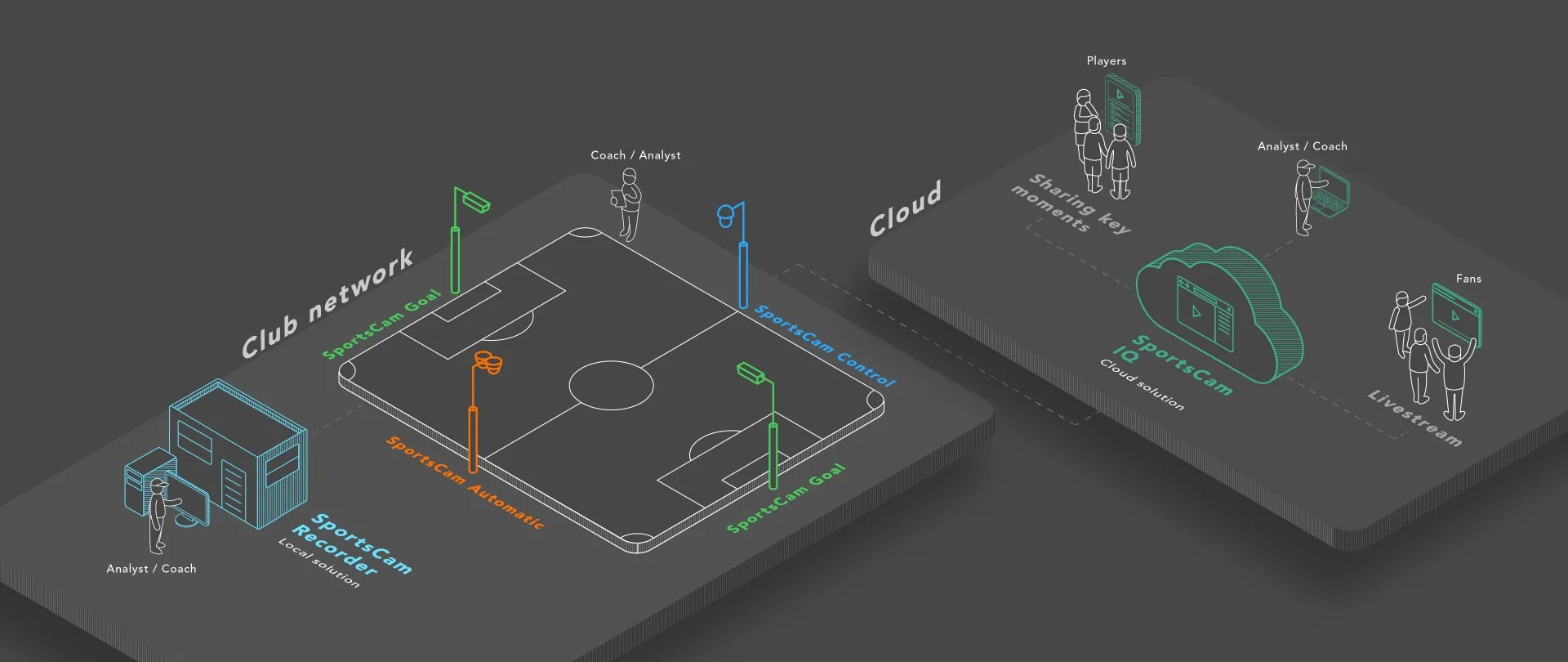
Provispo's on-premise architecture operates on a different principle: the cameras work regardless of internet status. Multi-camera angles capture in high quality with low latency to local storage, powering your entire workflow without depending on external connectivity. Coaches can review footage immediately after the match. Analysis can happen in real-time on the sideline. The system functions exactly the same whether the venue has gigabit fiber or no internet at all.
Cloud services have their place, for distribution, for remote access, for archive storage. But making them the foundation of your capture workflow means betting everything on the reliability of someone else's infrastructure, in an environment where that infrastructure routinely fails when you need it most.
The practical defense is threefold: on-premise processing and storage as the primary system, automatic quality adjustment for cloud uploads when connectivity is available, and the confidence that your core workflow never depends on network conditions you can't control.
Camera Alignment: Death by a Thousand Adjustments
Camera alignment failures are quieter than power or network issues, but they're insidious. A camera shifts two degrees after a windstorm. Vibration from nearby construction nudges the mounting bracket. Someone bumps the pole while performing maintenance.
Each incident is minor. Cumulatively, they degrade footage quality until a coach complains that half the pitch isn't in frame anymore. By then, weeks of matches have been captured with suboptimal angles.
Research from venue operations teams indicates that 15-20% of fixed camera installations experience alignment drift significant enough to require adjustment within the first season. The systems that handle this best make realignment simple enough for venue staff to manage without waiting for specialist support.
When Things Break: The Support Model That Makes the Difference
Technical specifications matter less than response time when systems fail on match day. A facility manager trying to broadcast in 45 minutes doesn't have time for ticket queues or escalation procedures.
This is why Provispo takes a fundamentally different approach to support. Every installation comes with dedicated one-on-one 24/7 support, not a call center, but direct access to technical specialists who know your system. Clients join a dedicated WhatsApp group for immediate communication, with first-line phone support available whenever needed: workdays, weekends, evenings, holidays.
The model is simple: when your match starts at 7 PM on a Saturday, technical expertise should be a phone call away, not an email thread that gets answered Monday morning. Industry data shows that direct support access resolves issues 60% faster than traditional ticket systems, but the real advantage isn't just speed, it's certainty. You know exactly who to contact, how to reach them, and that they'll respond when it matters.
Because match day has no tolerance for "we'll look into this during business hours."
Match Day Preparation: A Practical Checklist
72 Hours Before:
✅ Verify all power connections and test backup systems
✅ Run full network bandwidth test during anticipated streaming hours (if using cloud features)
✅ Check camera alignment and tighten any loose mounting hardware
✅ Confirm direct support contact information is accessible to staff
✅ Verify local storage capacity for complete match capture
24 Hours Before:
✅ Test complete recording workflow start to finish, including offline mode
✅ Confirm sufficient on-premise storage for multi-camera angles
✅ Review weather forecast for outdoor installations
✅ Brief venue staff on basic troubleshooting procedures
Match Day Morning:
✅ Power cycle all components and verify system startup
✅ Run 15-minute test recording and confirm local playback quality
✅ Check network stability for cloud features (but confirm local capture works independently)
✅ Verify support team availability aligns with match schedule
Post-Match:
✅ Document any issues or unusual behavior for pattern tracking
✅ Verify complete local capture of match footage
✅ Initiate cloud upload when optimal bandwidth is available
✅ Schedule alignment checks if any camera movement occurred
🔗 Download the Match Day Preparation: A Practical Checklist(PDF file)
Designing for Resilience, Not Perfection
The paradox of match day reliability is that it's rarely achieved through technical sophistication alone. The most consistent systems aren't necessarily the ones with the most features, they're the ones designed with operational reality in mind.
Infrastructure ownership is the foundation. When your core workflow depends on external services, cloud processing, remote storage, internet-dependent capture, you've outsourced control over your most critical operational moments. On-premise systems put that control back in your hands. The match gets recorded whether your internet works or not. Analysis happens with the latency of your local network, not the congestion of shared cloud infrastructure. Your footage lives where you decide it lives.
Clear ownership structures matter. When venue staff, integrators, and manufacturers all assume someone else is monitoring system health, problems compound silently until they surface during live operation.
Simple, repeatable checks matter. Systems that require specialized knowledge for basic diagnostics create dependencies that don't scale across multiple venues or staff turnover.
Redundancy matters. Not as a luxury feature, but as fundamental design philosophy, edundant power, redundant storage, redundant connectivity paths. And critically: the ability to function when connectivity isn't redundant but absent entirely.
And responsive support matters. Because even the best-designed system will eventually encounter an edge case that only human expertise can resolve quickly.
Eliminate match day uncertainty
Provispo takes a fundamentally different approach to support. Instead of ticketing systems, handovers, or outsourced helpdesks, customers receive direct, one-on-one access to the people who know their installation. Support is available 24/7, including evenings and weekends, with real-time communication through a dedicated WhatsApp group and first-line phone support when needed. When issues arise, there is no queue and no translation layer between the problem and the solution.
If you want to eliminate guesswork and ensure your video system performs under real conditions, we’re happy to help. We offer a no-obligation consultation to review your venue, workflows, and operational requirements, whether or not Provispo ultimately proves to be the right fit. You’ll receive practical, experience-based advice tailored to your environment.
Because your next match should depend on preparation, not crossed fingers.
💻 Contact our expert for a consultation
Contact Provispo
Website: provispo.com
Email: info@provispo.com
Phone: +31618088102